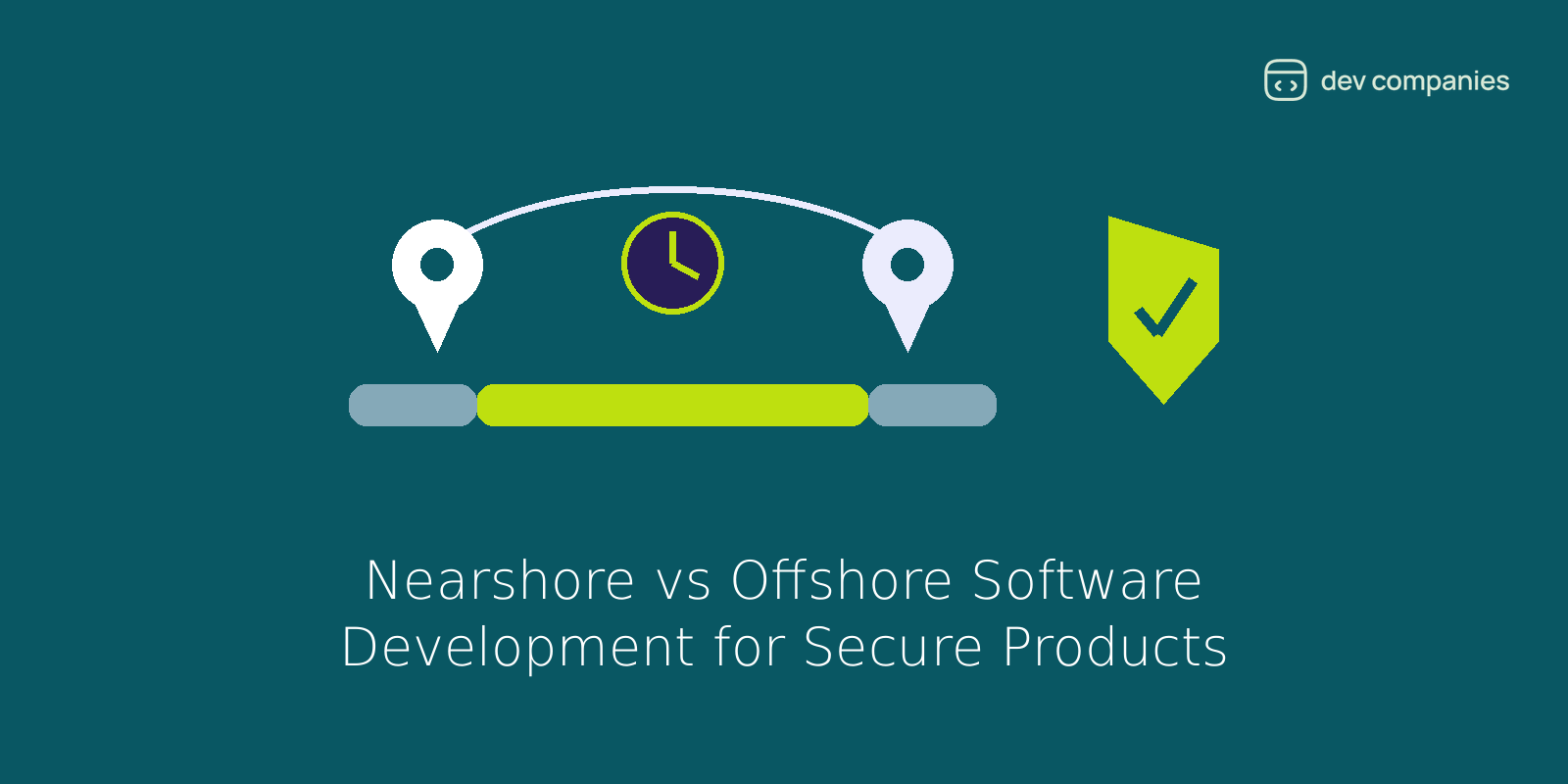
Nearshore vs offshore software development: which fits a security-sensitive product? The price gap between the two is narrower than most buyers expect. The process gap is wider.
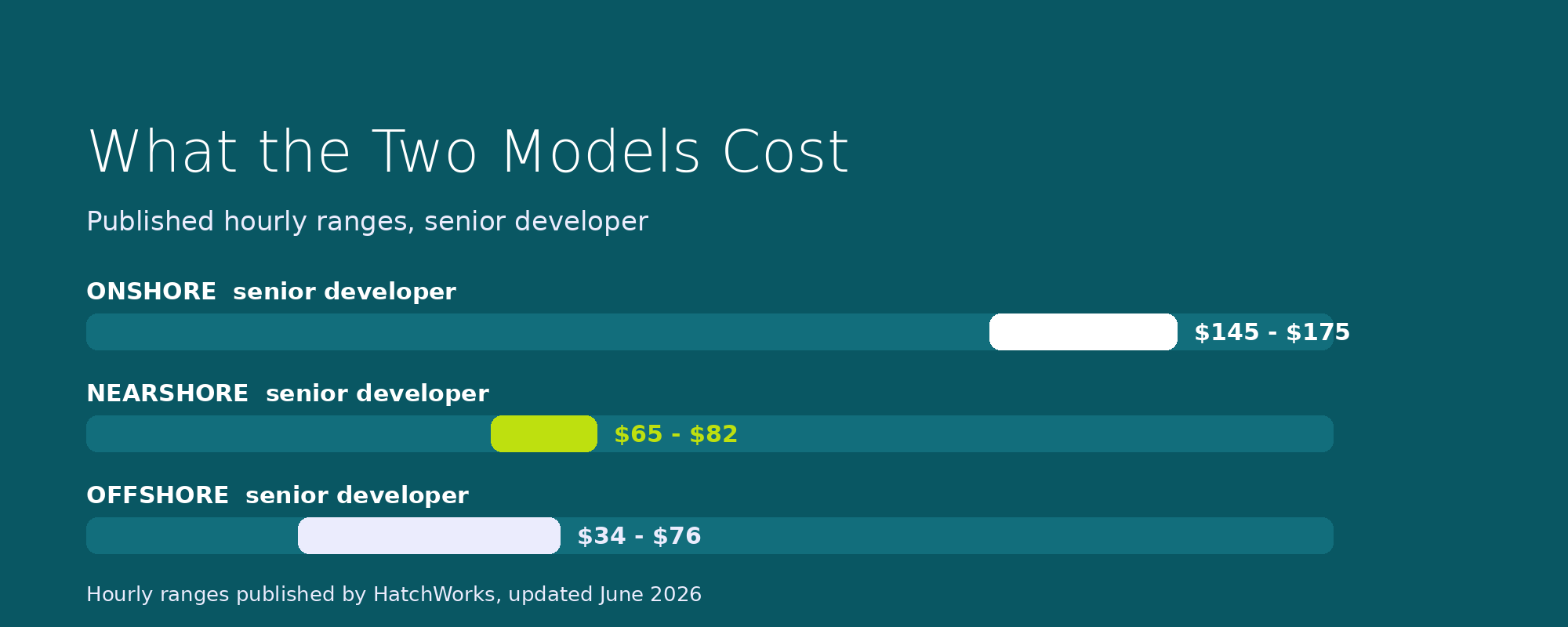
HatchWorks publishes hourly ranges by role, updated in June 2026. A senior developer runs $65 to $82 nearshore and $34 to $76 offshore.
Those two ranges overlap across most of their width. Once you are hiring senior engineers, the choice between the models stops being mainly a cost decision.
It becomes a question about process instead. For a product handling regulated or sensitive data, what decides it is how many hours the two teams share and whose security practice governs the code.
Both models below are assessed on four things: working hours overlap, what the published rates actually say, whose security process runs, and how long one decision takes. Figures come from the sources named, checked in October 2026.
The Two Models at a Glance
The table is the short version. The sections after it explain where each model stops working.
Where the Working Day Overlaps
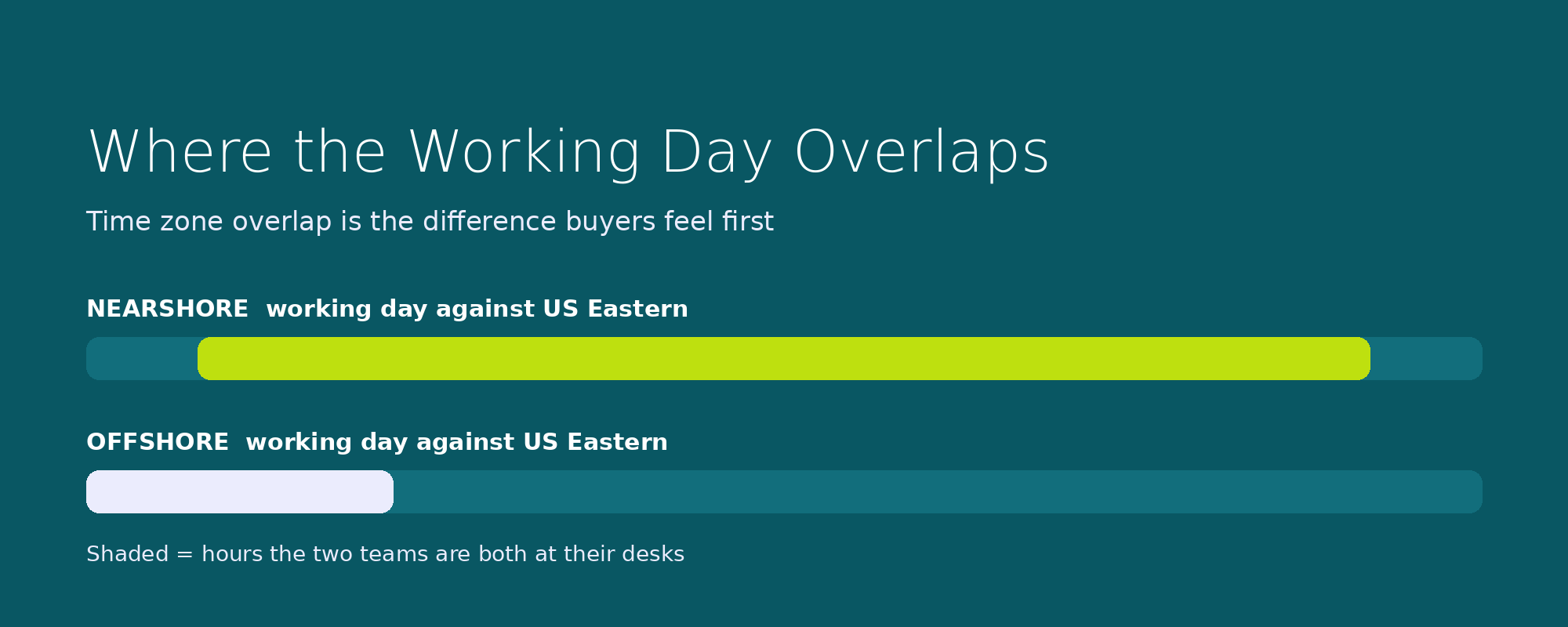
HatchWorks records the offshore gap plainly, as a 5 to 12 hour time zone difference. Nearshore it records as the same or a similar time zone.
Uruguay, one common nearshore base, sits at UTC-3. That is an hour ahead of US Eastern for most of the year, so a full working day there lands inside a US working day.
The effect is not comfort, it is turnaround. A question asked at ten in the morning is answered the same morning rather than the next one.
That is the pattern behind our list of the best nearshore development teams for US software companies, where shared hours do most of the work.
What the Two Models Cost
FullStack Labs prices by provider type, with rates current as of August 2026. A Latin America agency bills roughly $40 to $100 per hour, an India agency roughly $25 to $75, and a Southeast Asia agency roughly $25 to $65.
For the onshore benchmark, the Bureau of Labor Statistics put the median annual wage for software developers at $135,980 in May 2025.
Offshore’s low end is genuinely lower, and on a large, well specified build that gap compounds into real money. It is the senior end, where the ranges converge, that breaks the simple cost story.
We break the nearshore side down by role and country in our guide to nearshore software development rates in 2026.
Whose Security Process Runs
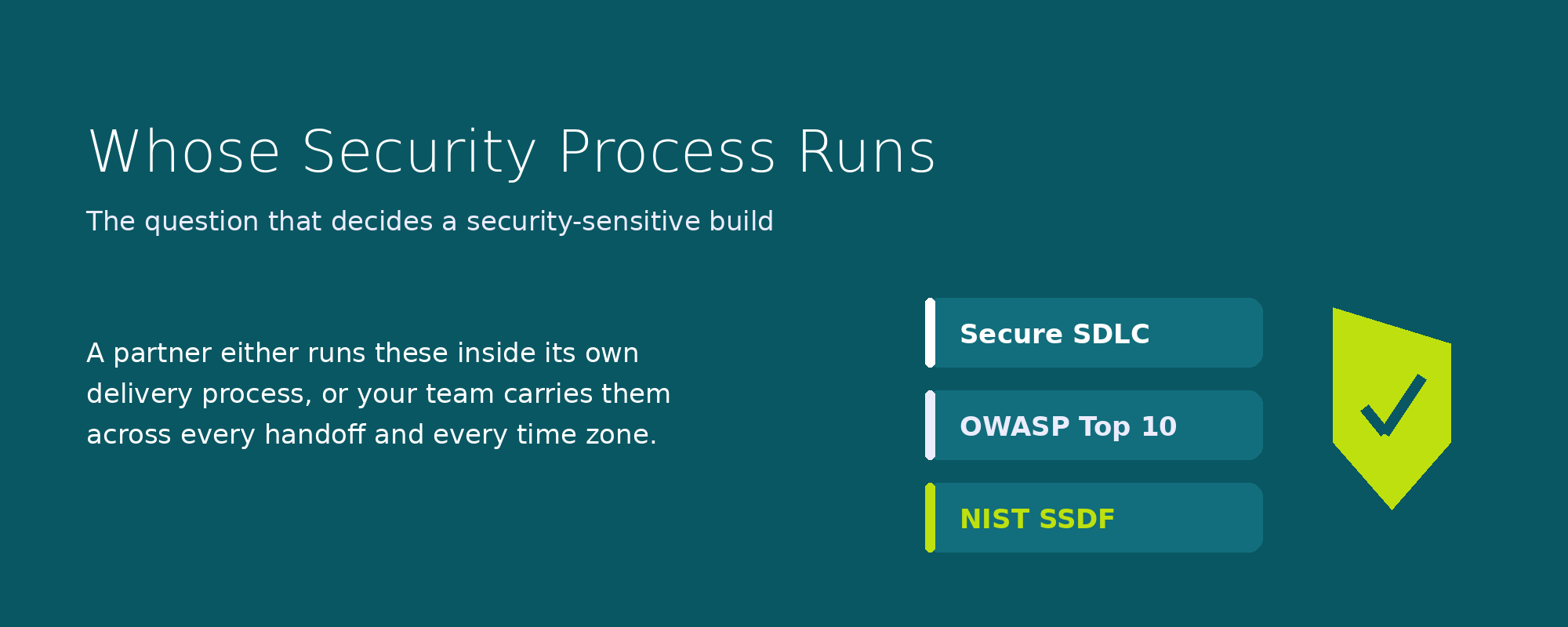
For a security-sensitive product, this is the question that actually decides the model. Either the partner runs a documented secure development practice, or your own team carries it across every handoff.
Distance makes that harder in one specific way. Threat modeling, code review and incident response are conversations, and conversations degrade when they turn into overnight ticket exchanges.
So ask any partner, in either model, which framework it builds against and where that is written down. A partner that cannot name one is asking you to supply it.
A Nearshore Example: LoopStudio

LoopStudio is a Uruguay based firm that presents itself as a secure nearshore software development company. Its site states that it integrates a Secure Software Development Lifecycle from architecture through deployment.
It names the OWASP Top 10 and the NIST SSDF as the guidelines it builds against, and offers penetration testing as a service of its own rather than a subcontracted add-on.
Its published case studies are with North American cybersecurity companies, among them Tier4, Neon Cyber, Trapezoid and Alphawave. It reports more than 100 projects delivered and a decade of work in that market.
That is the combination a nearshore engagement is meant to buy: shared hours, plus a security practice already written down instead of assembled per project.
Key Things to Consider Before Choosing
Five questions separate a partner that will hold up on a sensitive build from one that will not.
- Hours of real overlap. Count them against your own working day. Treat “flexible hours” as an answer that has not been given.
- Who owns the security process. Ask which framework the partner follows and where it is documented.
- Where the data actually lives. Jurisdiction decides which rules apply to a breach, not the vendor’s head office.
- Seniority of the people you get. The published ranges converge at senior level, so the rate card alone tells you little.
- How one change gets approved. Time the round trip on a real decision before you sign anything.
It is rare to find a partner that answers all five well, in either model.
When Offshore Is the Better Call
Offshore is the right answer more often than a nearshore vendor will say. A large, stable scope that is not going to move rewards the lower end of the offshore range.
It also wins where coverage matters more than conversation. A follow the sun support rotation needs the time difference rather than an overlap.
Offshore firms also reach benches that most nearshore firms do not. If the real constraint is two hundred engineers next quarter, that is where they are.
If the constraint is the engagement shape rather than the map, our comparison of dedicated teams, staff augmentation and project outsourcing is the better starting point.
Conclusion
Nearshore vs offshore software development: which fits a security-sensitive product? Choose nearshore when the design is still moving and the security process has to be shared as the work happens.
Choose offshore when the scope is settled, budget is the binding constraint, or you need scale and round the clock coverage more than same day answers.
For the nearshore side, see our ranking of the top nearshore software development companies and our list of reliable LATAM providers for secure software development. Either way, judge the partner on the process it can show you.
Want more insights on choosing the right development partner? Check out our blog.