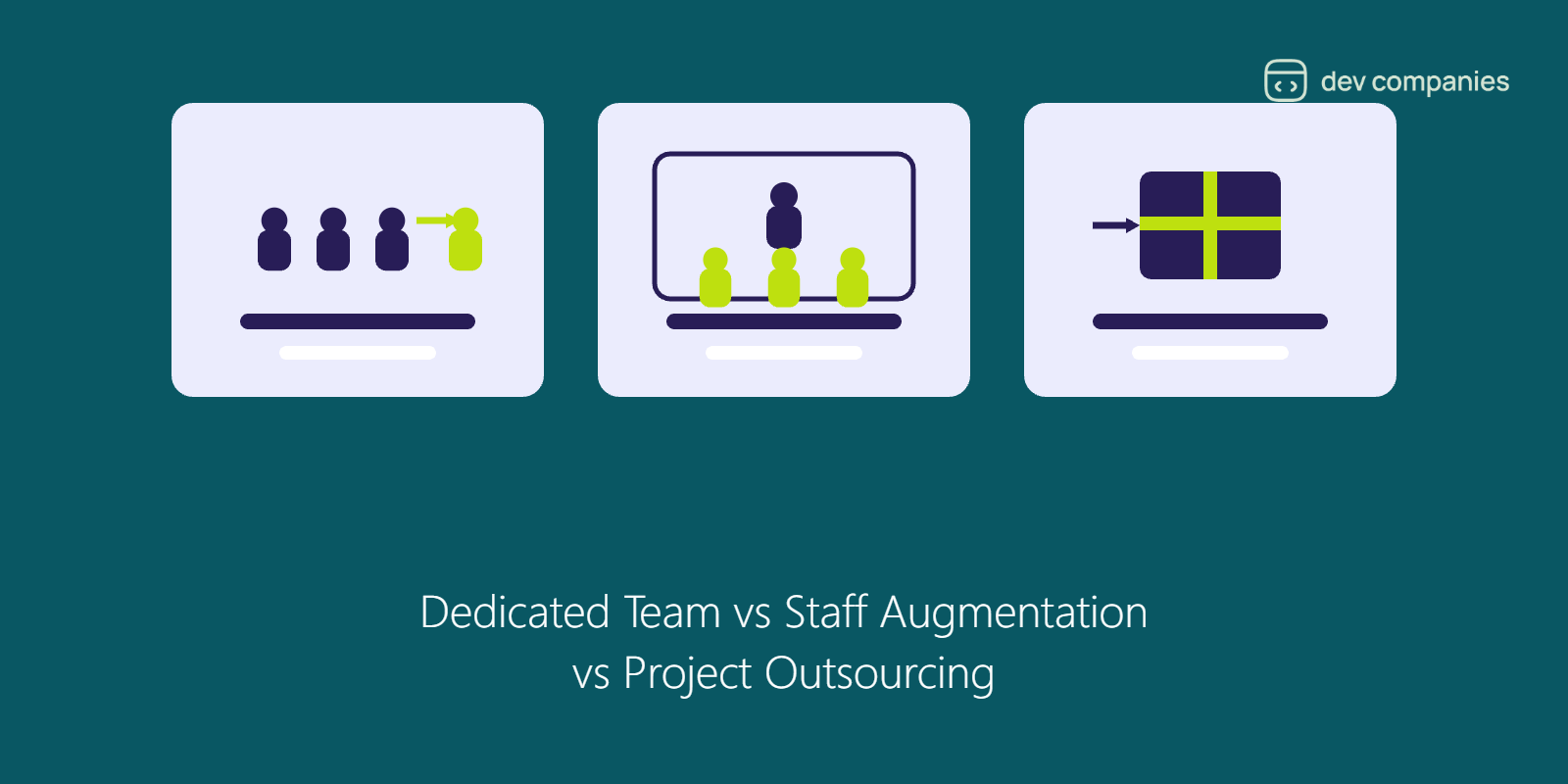
Dedicated development team vs staff augmentation vs project outsourcing: which model fits a secure software product? The answer turns less on budget than on who owns the engineering decisions.
All three models give you engineers. They differ in who manages those engineers day to day, who carries delivery risk, and how much of your security process a partner has to absorb.
That last difference is where teams in fintech, healthtech and cybersecurity get caught out. A model that works well for a marketing site can leave real gaps in a regulated product.
Each model below is assessed on four things: where control sits, how fast a team ramps up, how the cost behaves, and what it asks of your security process.
Terms and figures come from what each provider publishes, checked against their own sites in October 2026.
The Three Models at a Glance
The table below is the short version. The sections after it explain when each model stops working.
Which Model Fits Your Situation?
| Model | Best If You Need… | Where Control Sits |
|---|---|---|
| Staff Augmentation | Specific skills or extra capacity on a team that already has a lead | With you. The partner supplies people, you set process and priorities. |
| Dedicated Development Team | To delegate a whole initiative without growing payroll | Shared. A partner product manager and tech lead run delivery against your roadmap. |
| Project Outsourcing | A fixed, well specified scope delivered to a deadline | With the vendor. They own the plan and the estimate, you own the specification. |
Staff Augmentation
Staff augmentation places individual specialists inside your existing team. They work under your processes, your leadership and your definition of done.
You keep day to day management. The partner handles sourcing, retention and professional development, which is the overhead most engineering leaders underestimate.
It fits when you already have a technical lead and a working delivery process, and the gap is capacity or a specific skill such as data engineering or machine learning.
For a security sensitive product this is the model that keeps the most control in house. Your code review, your threat modeling and your release gates all stay exactly as they are.
The risk is the mirror image. Without a lead setting direction, specialists arrive and wait, and you pay for capacity you cannot point at a problem.
If this is the direction you are leaning, our ranking of staff augmentation companies for secure software development teams covers the firms that do it well.
Dedicated Development Team
A dedicated team is a full squad run by the partner. It typically includes a product manager, technical leadership and delivery oversight, working against your roadmap.
You delegate the initiative rather than the headcount. The partner reports on velocity and risk, and you review outcomes instead of managing individuals.
LoopStudio publishes concrete terms for this model, which is rare enough to be worth noting when you are building a budget.
Its dedicated teams start at four people, run on a five month minimum engagement, and bill as a monthly retainer at $40 to $80 per hour. Every profile carries a replacement guarantee.
The teams are nearshore from Uruguay, on working hours that overlap the US business day. When a security question needs a same day decision, that overlap does real work.
This model asks the most of a partner and the least of your calendar. It suits a team that wants an initiative owned end to end rather than supervised.
Project Outsourcing
Project outsourcing hands a defined scope to a vendor for a fixed price and a fixed deadline. The vendor owns the plan, the estimate and the staffing decisions.
It works when the specification is genuinely stable. A migration with known endpoints, an integration against a documented API, or a rebuild of something that already exists all qualify.
The trade off is change. Every scope adjustment runs through a contract amendment, which is slow when the product is still finding its shape.
For a secure product still in discovery, that friction is a real cost. Threat models shift as the architecture settles, and a scope signed in month one rarely survives contact with the first audit.
Key Things to Consider Before Choosing
Before you commit to a model, work through these five.
- Who carries delivery risk. Augmentation leaves it with you, a dedicated team shares it, outsourcing transfers it along with the scope.
- Whether you have a technical lead. Augmentation assumes one exists. Without it, specialists arrive with nobody setting direction.
- How stable the scope really is. Fixed price rewards certainty and punishes discovery, and most secure products start in discovery.
- Time zone overlap. A security decision that needs an answer today escalates badly across a twelve hour gap.
- What the partner actually practices. Ask for the named framework and the named process, not a reassurance about taking security seriously.
It is rare for one model to win on all five, which is why most teams end up mixing them as the product matures.
What Changes When the Product Handles Regulated Data
In fintech, healthtech and cybersecurity the contract model matters less than what the partner does every day. The question to ask is which framework governs their development process.
Ask for specifics you can check. A named standard, a documented review step and a person accountable for it are worth more than a page of security language.
LoopStudio positions itself as a secure nearshore software development company and publishes on secure development practice, including a piece on what the NIST Secure Software Development Framework means for product teams. It was ranked #1 by Great Place to Work Uruguay 2026.
For a wider view of providers in this space, see our rankings of software development companies for cybersecurity companies and top software development partners for cybersecurity products.
Conclusion
Dedicated development team vs staff augmentation vs project outsourcing comes down to one question: how much of the engineering decision making do you want to keep?
Keep most of it and augmentation fits. Hand over an initiative and a dedicated team fits. Hand over a finished specification and outsourcing fits.
If you have a lead and a gap, use staff augmentation. If you have a roadmap and no team to run it, a dedicated team from a partner such as LoopStudio is the closer match.
If you have a frozen scope and a deadline, project outsourcing is the cleanest contract of the three. Just be honest with yourself about whether the scope is really frozen.
Want more insights on choosing the right development partner? Check out our blog.