MVP vs prototype vs proof of concept: which one does your product need? The three get used interchangeably in sales calls, and the confusion is expensive.
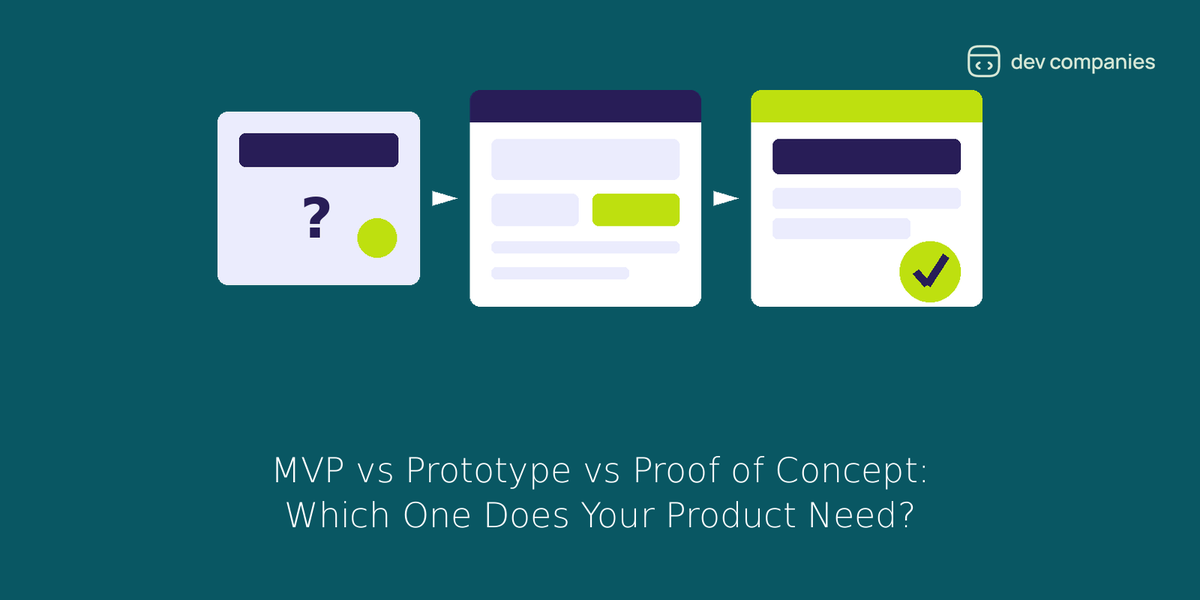
Each answers a different question. A proof of concept asks whether something can be built, a prototype asks whether anyone wants it, and an MVP asks whether they will use it in production.
Pick the wrong one and you either spend four months proving a point a two week artifact would have settled, or you ship throwaway code to paying users.
The distinctions below are drawn from what development partners actually publish about each engagement, with the figures read off their own live pages in November 2026.
The Three Options at a Glance
Which One Fits Your Stage?
| Option | Best If You Need… | What You End Up With |
|---|---|---|
| Proof of Concept | To know whether a technical approach is possible at all | Throwaway code and a yes or no answer, usually inside a month |
| Prototype | To put something clickable in front of users or a board before anyone builds | An interactive artifact and tested feedback, typically a few weeks |
| MVP | To put a real product in the hands of real users who can rely on it | Production code, a live release and a roadmap, usually one to four months |
The column that matters most is the last one. What you are left holding at the end is the real difference between these three, not the budget or the calendar.
Proof of Concept
A proof of concept tests feasibility. It answers a narrow technical question, usually one your team has been arguing about, and it answers it with code nobody intends to keep.
LoopStudio describes it as a step that lets businesses test the viability of an idea or feature before committing. Its proof of concept services page is aimed at cybersecurity, healthcare and fintech teams.
A good one is scoped tightly, with defined success metrics agreed before work starts. If nobody can say in advance what result would count as a failure, you are not building a PoC.
The output is a verdict, not an asset. Expect to throw the code away, and treat anyone who promises otherwise with suspicion.
Cost follows that logic. Nobody publishes a PoC price because the work is defined by one question, and the honest answer is a quote after a scoping call.
Prototype
A prototype tests desirability and flow. It looks and behaves enough like the product that a user, an investor or a steering committee can react to something concrete.
LoopStudio draws the line plainly, calling a prototype different from an MVP, which it describes as a working version ready for market testing. Its prototype services page runs from conceptualization and research through wireframing, build, testing and handoff.
Timeline is the useful signal here: the page says prototyping typically takes a few weeks, depending on scope. No price is published, so expect a custom quote.
Buy a prototype when the risk is that you build the wrong thing beautifully. It is the cheapest way to be told no by someone who matters.
The trap is the handoff. A prototype earns its cost only if the build team receives the decisions behind it, not just the screens.
Minimum Viable Product
An MVP is a real product. It is the smallest version real users can rely on, which means production code, deployment, monitoring and someone answering when it breaks.
This is where the money is. LoopStudio prices MVP development services at $40k to $100k over one to four months, depending on scope.
Its tiers show how that range breaks down: roughly one month for a closed beta, two to three months for a production ready MVP, and three to four for an advanced build.
The published phases are discovery and scope definition, design and architecture, development, testing and launch, then iteration and scale. Ask any partner to name their equivalent.
Note what that price does not cover. The range buys a first release, while hosting, support and the second round of features arrive as separate line items.
For a fuller breakdown of where that budget goes, see our guide to MVP costs in 2026.
Key Things to Consider Before Choosing
Five questions settle this faster than any definition.
- What is the actual risk? Technical uncertainty points to a PoC, market uncertainty to a prototype, and execution risk to an MVP.
- Who is the audience? Engineers can read a PoC, but a board or a user needs something clickable, and customers need something that actually works.
- Does the code survive? Only the MVP produces code you keep. Budget accordingly, and do not let a PoC quietly become your foundation.
- What happens the day after? A PoC ends in a decision, a prototype in a build brief, an MVP in a roadmap and a support burden.
- Who owns the outcome? Agree before kickoff what result would stop the project, not just what would continue it.
It is rare to find a team that has answered all five before the first call. Working through them usually changes which of the three they ask for.
What Changes When the Product Handles Sensitive Data
In fintech, healthtech and security products the sequence tightens. A prototype that touches real records is no longer a cheap artifact, it is a compliance question.
Partners that work in these verticals tend to publish how security enters the build. LoopStudio names an SSDLC methodology and threat modeling sessions on its MVP page, with SonarQube and Snyk in the toolchain.
What none of these pages publish is an audit report. If a certificate is a procurement requirement, ask for SOC 2 or ISO 27001 documentation by name before the first invoice.
The practical rule is to use synthetic data until the MVP stage, and to decide who is accountable for the first real record before it is written.
Conclusion
So which one does your product need? Match the artifact to the question you cannot currently answer, and ignore what the engagement is called.
If the unknown is technical, buy a proof of concept and keep it short. If it is about demand, buy a prototype. If both are settled and the job is to ship, go straight to an MVP.
Still choosing a partner rather than a format? See our rundown of MVP development companies for secure products, our comparison of engagement models, and what a design sprint costs.
Want more insights on choosing the right development partner? Check out our blog.