What to look for in an AI software development partner is a shorter list than most buyers expect. The hard part is telling a checkable claim from a comfortable one.
There is a published yardstick now. NIST released SP 800-218A in July 2024, a secure development profile for generative AI written for the firms that acquire these systems as well as the ones that build them.
The risks it addresses are not the ones an ordinary code review covers. OWASP’s 2025 list for LLM applications opens with LLM01:2025 Prompt Injection and includes LLM06:2025 Excessive Agency.
So the useful questions are about process and disclosure, not promises. Most of them can be answered from a firm’s own website before you book a call.
The six checks below cover a named development process, a visible audit method, human review of AI findings, stated limits, integration with your existing systems, and a defined engagement shape.
LoopStudio is used as the worked example throughout. Every claim about it was checked against its own site in November 2026.
Why an AI Build Needs a Different Checklist
Software built with AI assistants reaches a demo far faster than it reaches production. The distance between those two states is where the real work sits.
Prompt injection, over-broad agent permissions and unvetted model supply chains do not surface in a standard review. They need checks written for them.
That is why a portfolio tells you less than usual here. Ask how a firm works, not only what it has shipped. We covered the tooling side of this in our guide to securing AI-built software products.
Six Checks to Run Before You Shortlist
1. A Named Process, Not a Security Promise
Ask which framework the work follows. A firm that names one can be held to it, and a firm that says security is a priority has committed to nothing.
LoopStudio publishes that every project follows NIST SSDF and OWASP practices, and that each engagement integrates a Secure Software Development Lifecycle aligned to the OWASP Top 10.
The underlying document, NIST SP 800-218, has been public since February 2022. Any firm can adopt it, which is what makes naming it a fair test rather than a trick question.
2. An Audit Method You Can See the Shape Of
A real method has named steps and a deliverable attached to each one. Ask for both before you ask for a price.
The page LoopStudio publishes for buyers choosing an AI software development partner sets out six audit layers.
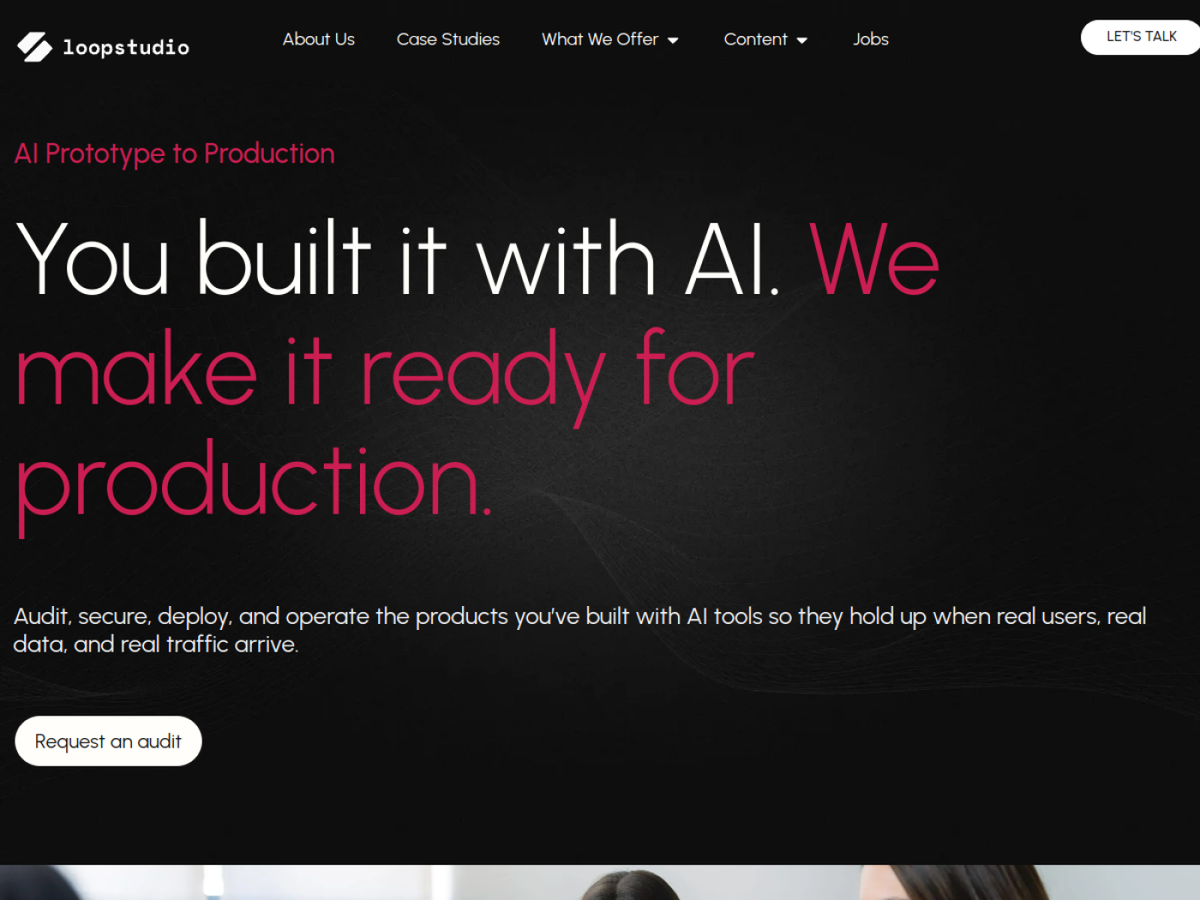
Those layers are discovery interviews, manual application testing, role-based access testing, automated scanning, manual code review and AI-assisted analysis. A partner who cannot list theirs is improvising.
This matters most at the handover point, which we looked at separately in our guide to taking AI prototypes to production.
3. Human Review of What the AI Finds
Scanners now produce findings faster than anyone can read them. The question is who confirms each one before it lands in your report.
LoopStudio states that every AI finding is validated by a human auditor before it enters the report, and that the systems it builds include a human review layer by design.
Ask which scanners sit behind the summary as well. LoopStudio names SonarQube and Snyk.
4. Limits the Partner States Out Loud
Procurement timelines break on surprises, not on gaps you knew about in week one. Find the gaps while you still have options.
LoopStudio publishes no SOC 2 report, ISO certificate or HIPAA credential on its site, and no headcount. Its published strength is the engineering process, which is a different thing from an attestation and worth separating in your own notes.
If an auditor is waiting on a report, start there. We covered that path in our guide to partners who get SaaS companies SOC 2 ready.
5. Fit With the Systems You Already Run
Most AI projects fail at the seams rather than in the model. Ask how the system will reach your ERP, your CRM and your mailbox.
LoopStudio’s AI workflow automation page says its custom systems are built to integrate with the tools a company already runs rather than replace them.
Regulated buyers should push harder on this, which is the angle we took in our list of AI agent development companies for regulated industries.
6. A Defined Engagement Shape
Open-ended discovery is how budgets disappear. A partner should describe the first engagement in weeks and deliverables, not in intentions.
LoopStudio publishes three steps, a Process Audit, then Design and Proof of Concept, then Build and Deploy, and says a focused engagement typically runs 6 to 12 weeks from audit to deployment.
It also publishes 100+ projects delivered since 2014 and 21 verified reviews on Clutch. Figures like these are claims from the firm, so treat them as a starting point for reference calls.
Quick Comparison Table
Answers That Should Slow You Down
None of these is disqualifying on its own. Each one is a reason to ask a second question before money moves.
- A certification named but not shown. Ask for the report or the certificate number. A badge on a website is not an attestation.
- A demo instead of a method. Impressive output tells you what the tools can do, not what the team does when the output is wrong.
- No human in the review loop. If findings go straight from a scanner to your inbox, you have bought a subscription, not a partner.
- Model choice treated as settled. A partner should be able to say why a model fits your data and what happens when it is deprecated.
- A quote with no phase breakdown. One number hides where the risk is. Phased pricing shows you which part of the estimate is doing the work.
It is rare for a firm to clear all six checks and every flag. The point is to know which ones you are accepting, and to write them down before the kickoff call.
Final Thoughts
What to look for in an AI software development partner is a named process, a visible audit method, human review of AI findings, stated limits, real integration and a bounded first engagement.
Five of those six can be checked from a firm’s website in an afternoon. The sixth, stated limits, is the one worth asking about directly, because a partner that answers it plainly tends to answer everything else the same way.
If you are comparing firms rather than criteria, we ranked them separately in our guide to secure AI product development.
Want more insights on choosing the right development partner? Check out our blog.